

I.Published in a Top-Tier Journal: JACS — The “Gold Standard” in Chemistry and Chemical Biology
This breakthrough study has been published in the Journal of the American Chemical Society (JACS), one of the most prestigious and influential journals in the chemical sciences (Impact Factor: 15.6). Often regarded as the “Nature of Chemistry,” JACS has, since its founding in 1879, been dedicated to publishing landmark discoveries across chemistry, materials science, and chemical biology.
Only work demonstrating true conceptual innovation and rigorous scientific impact is accepted. This publication marks the first time OptoSeeker Biotech’s DropletBot® Digital Microfluidic Platform has supported researchers in reaching JACS, underscoring the system’s innovation and international recognition in next-generation biomolecular detection.
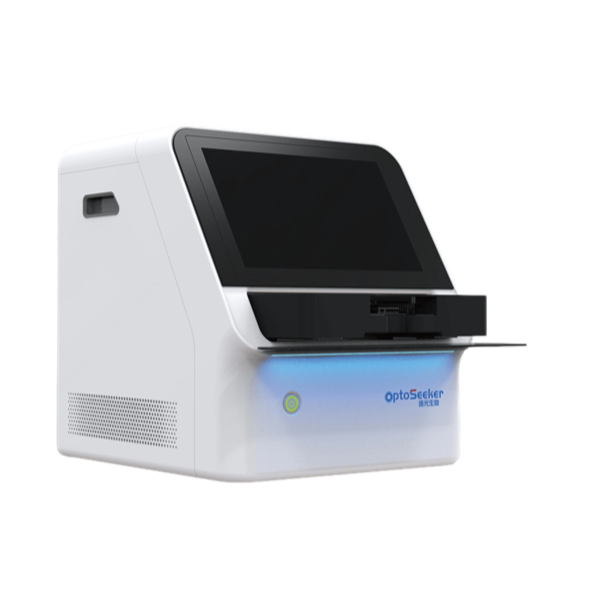
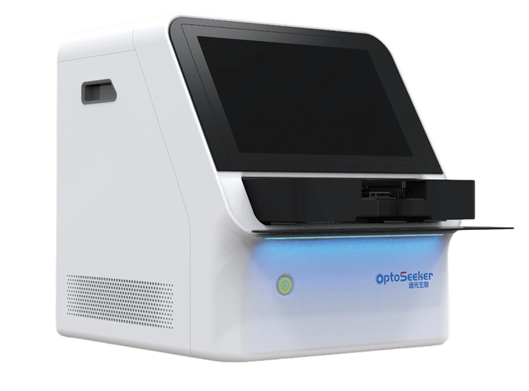 DropletBot® Digital Microfluidic Platform
II. Research Highlights: “Dual-Digital” Strategy Breaks Through Sensitivity Limits and Redefines Ultra-Sensitive Diagnostics
Traditional immunoassays often face limitations such as insufficient sensitivity, high background noise, and complex manual workflows, making it difficult to detect trace-level biomarkers important for early cancer detection, cardiovascular risk assessment, and other clinical applications.
In this study, researchers introduced a Dual-Digital (DDA) detection strategy, integrating the DropletBot® Digital Microfluidic Platform with CRISPR-based signal amplification. This approach delivers three major breakthroughs:
1) Orders-of-Magnitude Sensitivity Leap
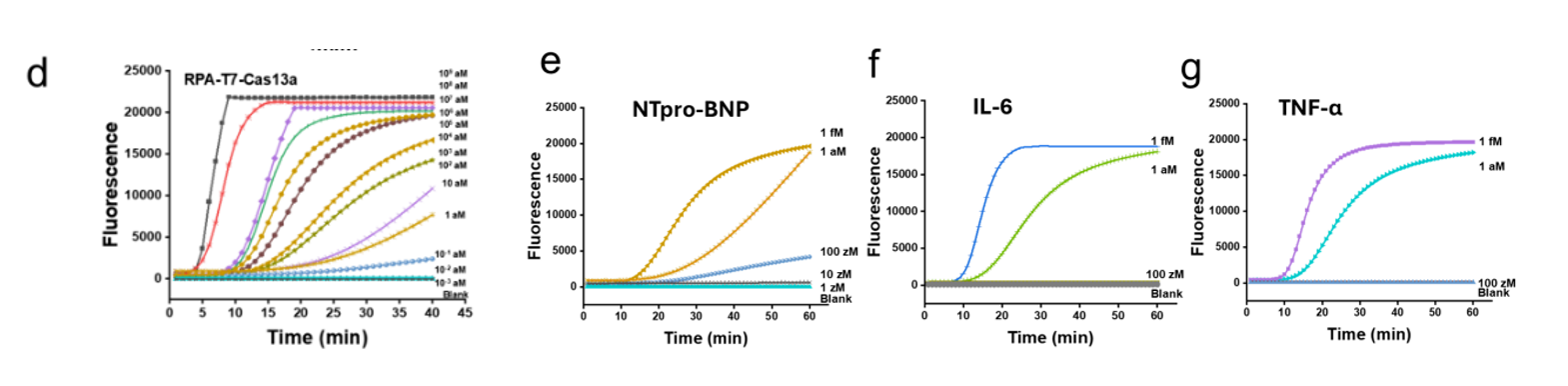
The DDA assay achieves zeptomolar (zM, 10⁻²¹ mol/L) detection limits, reaching a LoD as low as 100 zM for key protein biomarkers—over 100× more sensitive than leading commercial ultra-sensitive platforms.
(Performance supported by fluorescence readouts in Figure 2e–g of the original publication.)
2) Fully Automated Workflow: “Sample In, Answer Out”
From immunocapture and multi-step washing to CRISPR amplification and digital readout, all steps are integrated into a hands-free workflow requiring no operator intervention. Results are generated within 1 hour, resolving common challenges of manual assays.
(See the 12-step automated workflow illustrated in Figure 4a.)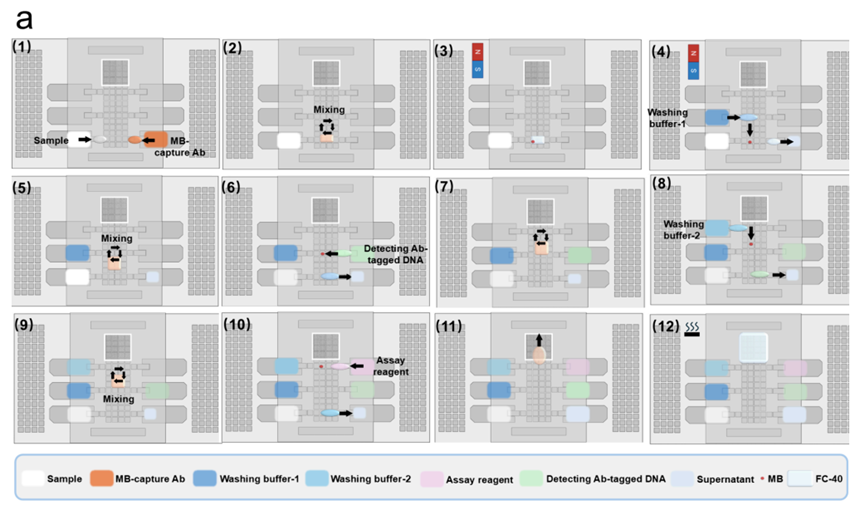
3) Robust Compatibility with Complex Clinical Matrices
In human serum, the DDA platform accurately quantified NT-proBNP (LoD 1 aM), IL-6 (LoD 1.5 aM), and TNF-α (LoD 2.5 aM) without extensive sample preparation, demonstrating excellent resistance to matrix interference.
(Clinical comparison data available in Figure 6b–e.)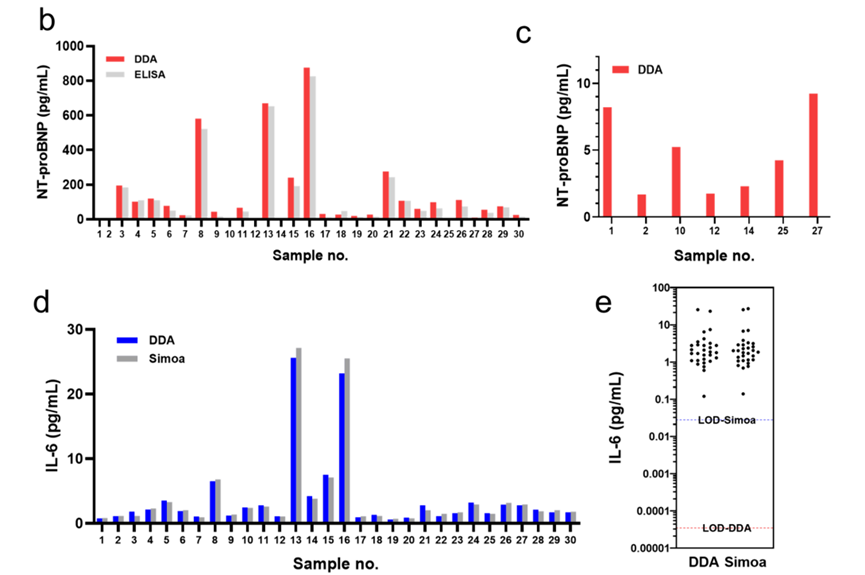
The platform’s zeptomolar sensitivity arises from the synergistic integration of DropletBot®’s digital microfluidics with CRISPR/Cas13a signal amplification. The overall system includes three core molecular detection modules and one fully automated closed-loop workflow, enabling digital quantification from target capture to single-molecule readout.
1. DropletBot® Digital Microfluidic Chip
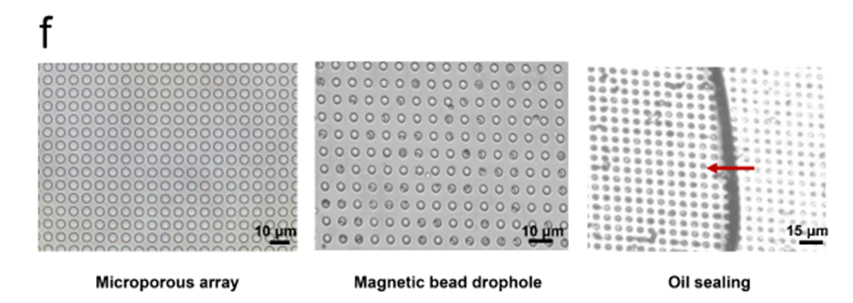
The chip features a high-density microwell array with engineered hydrophilic/hydrophobic surface patterns for programmable droplet manipulation. Approximately 10⁶ microwells (3.5 μm in diameter) are designed to accommodate single 2 μm magnetic beads, achieving >90% single-bead occupancy under magneto-gravitational loading.
This architecture establishes millions of independent microreactors for single-molecule separation and counting.
(Design illustrated in Figures 3a–f.)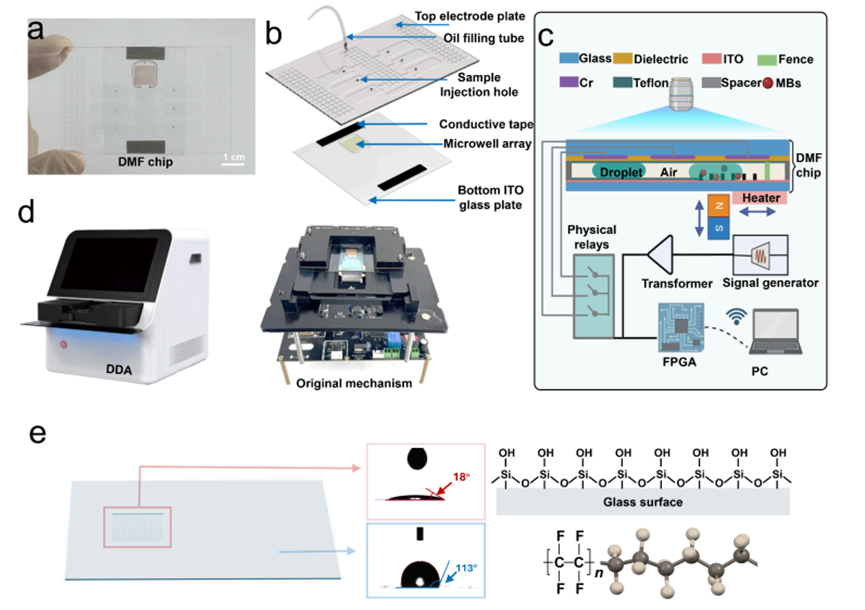
2. Magnetic-Bead Immunocapture System
Capture antibodies immobilized on magnetic beads bind target proteins, while detection antibodies are conjugated to DNA barcodes containing T7 promoters. This transforms protein recognition events into nucleic acid amplifiable signals, forming a classical sandwich immunocomplex.
(Mechanism described in Figure 2a.)
3. RPA–T7–Cas13a Cascade Amplification
The DNA barcode undergoes recombinase polymerase amplification (RPA), followed by T7 transcription to produce abundant RNA molecules. These trigger Cas13a collateral cleavage of RNA reporters, generating strong, localized fluorescence signals detectable at the single-microwell level.
(Amplification principle shown in Figures 2a and 2c.)

(B) Fully Automated Closed-Loop Workflow: DropletBot® Powers End-to-End Integration
DropletBot® orchestrates the entire process—from sample incubation and bead washing to droplet generation, microwell loading, oil sealing, isothermal amplification, and fluorescence imaging.
After amplification, the system digitizes target concentration by directly counting positive and negative wells, achieving true digital protein quantification.
(Workflow and optimization shown in Figures 4a–c.)
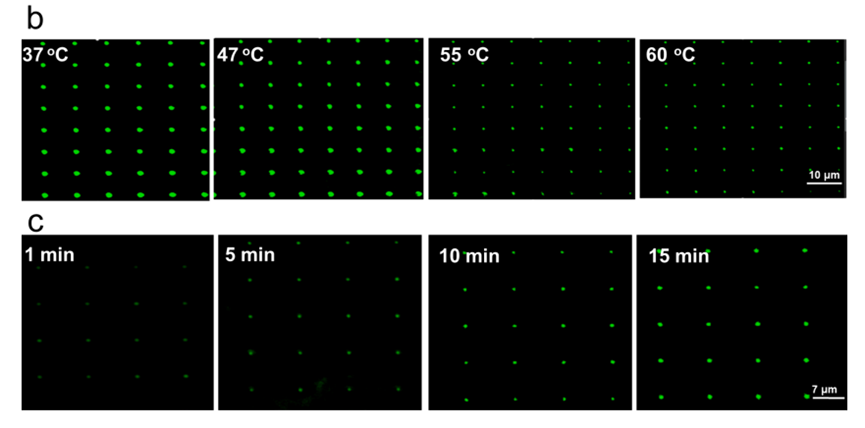
In summary, DropletBot® provides precise droplet and microwell control, the immunocapture system ensures target specificity and digital conversion, and the RPA–T7–Cas13a cascade enables strong single-molecule signal generation—together forming the foundation of the DDA assay.
(A) Outstanding Analytical Performance
1. Sensitivity
In 25% serum matrix, LoDs reached:
- NT-proBNP: 1 aM
- IL-6: 1.5 aM
- TNF-α: 2.5 aM
This corresponds to detecting ~60 molecules in a 100 μL sample.
(Validation shown in Figures 2d–g and 5f–h.)

2. Specificity
No detectable cross-reactivity with non-target proteins (e.g., IL-1, AFP), with background signals comparable to blanks.
3. Broad Dynamic Range
Quantitative linearity spans 4–5 orders of magnitude (0.1 aM to 1 pM), enabling early-disease detection and high-concentration monitoring on a single platform.
(Figure 5f–h.)
4. Precision
CV <5% across core quantification ranges; CV <20% near the LoD, exceeding clinical assay standards.
(B) Clinical Validation: Addressing Real Diagnostic Challenges
1. vs. Commercial ELISA
Across 30 clinical serum samples, DDA detected NT-proBNP concentrations that ELISA failed to quantify (e.g., 1.68 pg/mL and 1.74 pg/mL), providing crucial early-stage diagnostic insights.
(Figures 6b–c.)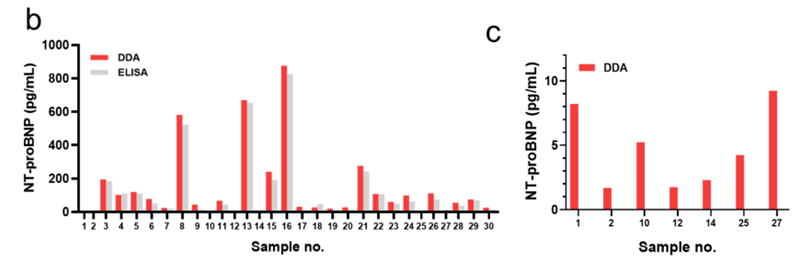
2. vs. Ultra-Sensitive Simoa
For IL-6, the DDA assay achieved a LoD of 0.000035 pg/mL, ~800× more sensitive than Simoa (0.028 pg/mL). The two platforms showed strong concordance (R = 0.998), while DDA maintained superior discrimination at ultra-low levels.
(Figures 6d–e.)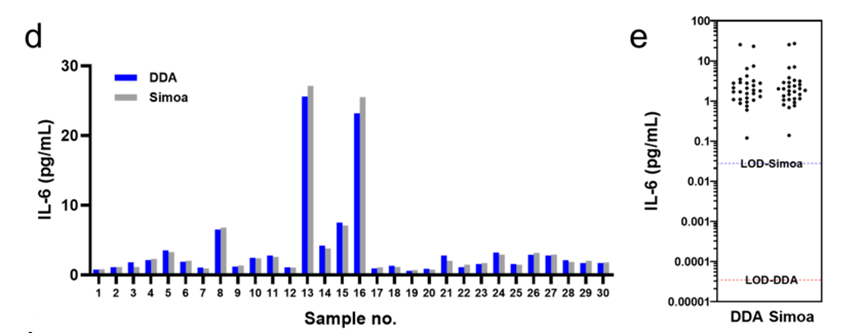
This enhanced resolution is critical for capturing subtle inflammatory changes at subclinical stages.
3. Multiplex Biomarker Profiling
Simultaneous quantification of NT-proBNP (cardiac stress) and IL-6 (inflammation) revealed correlated biomarker patterns, offering new insights into complex disease mechanisms and enabling more precise patient stratification.
(Figure 6f.)
The DropletBot® Digital Microfluidic Platform is an automated EWOD-based system that manipulates discrete droplets on hydrophobic surfaces by modulating contact angles via electric fields. It supports programmable droplet operations across multiple channels with dynamic impedance sensing for real-time monitoring of droplet position, velocity, and electrostatic behavior.
DropletBot® is widely applicable in diagnostics, chemical synthesis, cellular assays, and biomolecular analysis, offering modular hardware design and an intuitive user interface.

Click to learn more about the product
Original Publication:
Unlocking Zeptomolar Single-Molecule Detection by Synergizing Digital Microfluidics and Digital CRISPR
DOI: 10.1021/jacs.5c15767